
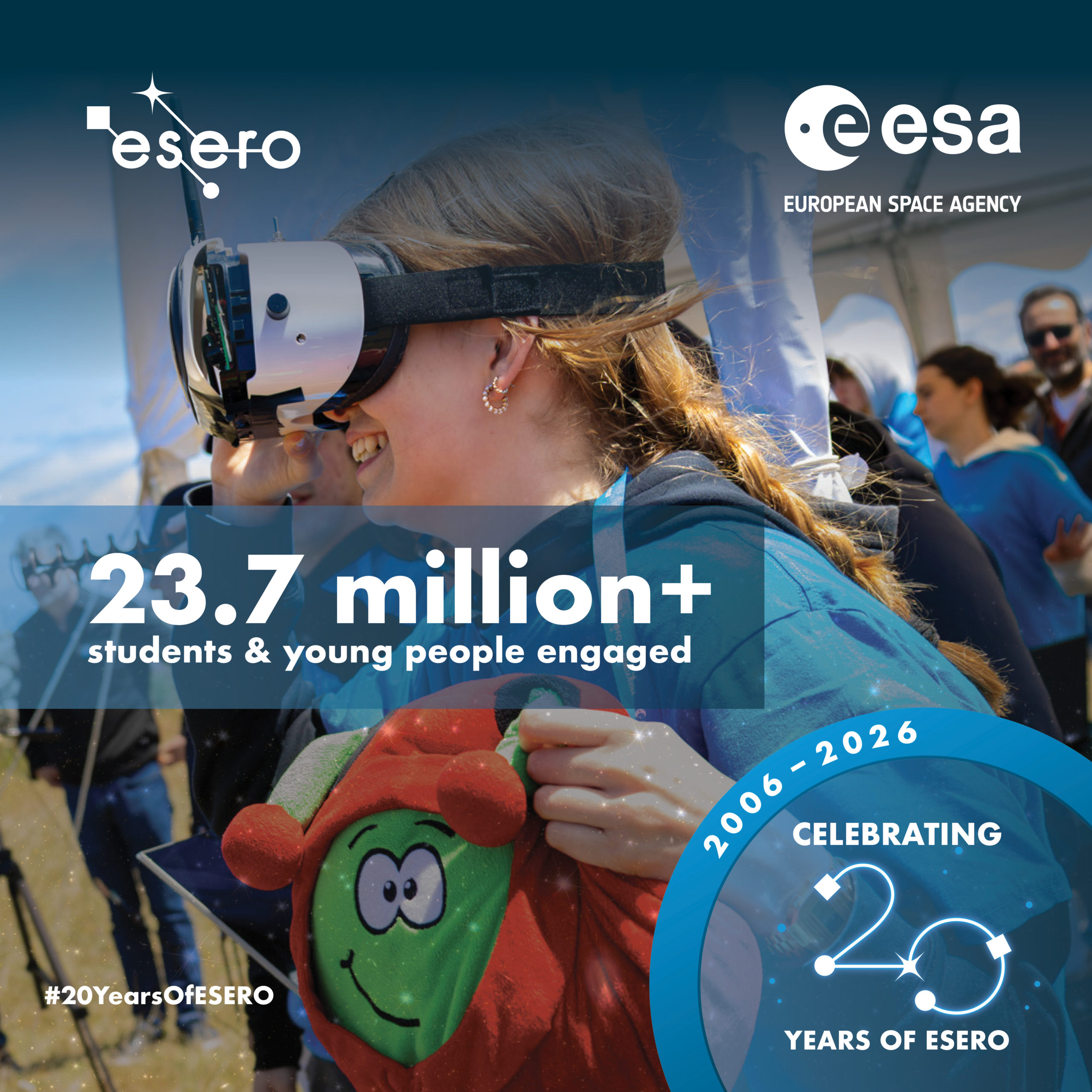
Caption: Celebrating 20 years of ESERO – Credit: ESA
In 2006, ESA launched the first European Space Education Resource Office (ESERO) in the Netherlands. Its mission was clear and ambitious: support teachers to use the excitement of space to inspire students to engage with science, technology, engineering, and mathematics (STEM). Two decades later, ESERO has grown into ESA’s largest and most influential school-level education initiative.
The pilot ESERO was established at NEMO Science Museum in Amsterdam, under the auspices of the Dutch Minister of Education, Culture and Science. But what began as a pilot project, soon expanded across Europe, laying the foundations for a Europe-wide education network.
Active across 22 ESA Member States, with Latvia and Lithuania expected to join in 2026, the network has reached millions of children (from ages 3-18), teachers, and educators.
Reflecting on its impact, Hugo Marée, Head of the ESA Education Office, explains, “I’ve seen the ESERO project grow from its early days into a strong, wide-reaching network, and what stands out most is how it works in real classrooms. Space is often seen as something distant, but in education it can make learning tangible and engaging. Through ESERO, teachers are given the tools to bring challenging topics into their lessons in new ways, creating opportunities for students to collaborate, work with real data, and experience STEM hands-on. What makes the difference is that this is not a one-size-fits-all approach, but something that takes shape in each country to reflects its own classrooms, its own teachers, and its own students.”
STEM that feels real
The goal of the ESERO project is not simply to teach facts about space science, rockets or satellite missions. Its purpose has always been broader: to use space to make STEM subjects exciting, relevant, and make their valuable for society clear.
With ESERO, in and outside classrooms across Europe, students have built miniature satellites as part of the CanSat competition, investigated climate change and Earth’s environment using satellite imagery through Climate Detectives, written computer codes for the International Space Station with Astro Pi, designed future space habitats in Moon Camp and trained like astronauts as part of Mission X. ESERO offices have also boosted inspiration with events such as live educational calls with ESA astronauts orbiting hundreds of kilometres above Earth. For years now, these experiences have contributed to completely changing students’ perception of STEM.
“Learning about space was exciting and fun,” recalled students involved with ESERO Greece. “We felt like real astronauts while learning science in a completely new way.”
Another student described how taking part in CanSat reshaped their future ambitions: “This project changed the way I think about my future studies and career.”
ESERO activities also extend beyond the classroom into after-school activities, science clubs, observatories, museums and science centres.
A local approach to a shared goal
Although all ESEROs share common objectives, the activities implemented in each country are adapted to the national curriculum, language(s), space priorities, and educational needs. At international level, ESA assures cross fertilisation of knowledge and expertise across the network and provides access to space expertise, missions, astronauts, and international interdisciplinary educational projects. The result is a unique European education network: strongly connected internationally, while grounded in national needs and priorities.
In Sweden, children learn about sustainability through apple trees grown from seeds that travelled to space. In Greece, early learners explore Earth observation through creativity and art. In Italy, students take part in live-action Mars base roleplay activities, solving emergencies while learning about robotics and science. Interested in some numbers? In Portugal, teacher-training programmes connected to Space Sciences and Earth observation have reached more than 5% of all primary and early-childhood teachers through the Ciência Viva network.
Meanwhile in the UK, large-scale online events such as Mars Day and Protecting Our Planet Day engage hundreds of thousands of students every year with topics ranging from planetary exploration to Earth observation. ESERO-UK has even built an impressive library with more than 900 space-related teaching resources, while the Space Education Quality Mark recognises schools that use space to enrich learning across the curriculum.
Supporting teachers and educators
ESERO supports teachers through inspiring, curriculum-aligned resources, training, and classroom activities that use space for STEM education.
Teachers often describe ESERO activities as a rare opportunity to bridge the gap between STEM theories and their real-world application, strengthening their capacity to spark curiosity and connect STEM to students’ everyday life and future career pathways.
“Among the many resources I have integrated into my teaching, the method and materials provided by ESERO Italy, and the Climate Detectives project in particular, have had an extraordinary impact on the classroom,” said one Italian teacher. “The activities fostered collaboration and the sharing of ideas between the students, creating a stimulating and collaborative learning environment.”
“This training contributed to my professional development in many ways, from updating my knowledge, to new ideas for classes, inspiring me for new activities, and fostering greater motivation and enthusiasm for the space sector,” stated another teacher who attended an ESERO teachers’ conference in Portugal.
In Germany, a teacher described the CanSat competition as “a rollercoaster of emotions”, where students experience both setbacks and breakthroughs while solving real engineering challenges. “That’s an experience we simply cannot offer in everyday school life,” another German teacher emphasised.
Building long-term change in the national school education ecosystem
A practical, inquiry-based approach and the use of innovative didactic methodologies is one of ESERO’s defining strengths. Rather than traditional knowledge transfer approaches through textbooks, lectures and structured exercises, ESERO activities foster experimentation, teamwork, interdisciplinarity, design thinking, and problem solving. Students analyse satellite data, build sensors, investigate environmental questions, tackle open questions, and work through scientific methodologies.
In many cases, ESERO activities have become deeply embedded within national education systems. ESERO resources are now integrated into teacher-training frameworks, national STEM strategies, and even formal curricula in several countries. One example for all: in Ireland, ESERO’s long-term work has aligned with wider curriculum developments, including the inclusion of Earth and Space within the new Junior Cycle Science specification.
Looking ahead
The network has grown greatly over the years. By the end of 2025, ESEROs were working alongside more than 530 national partner organisations, including universities, museums, science centres, space companies, observatories, government ministries, teacher associations, and student groups. And ESA’s ESERO project continues to grow and evolve, staying at the forefront of innovation in education as part of ESA’s Space for Education 2030 vision.
As society continues to face challenges linked to climate change, sustainability, digital literacy, and future workforce skills, ESERO has proven to be part of a long-term investment in society. Looking toward the next generation of scientists, engineers, teachers, and problem-solvers, ESERO aims to ensure that space remains a source of inspiration, curiosity, creativity, and opportunity.
Twenty years after its launch, ESERO’s greatest achievements extend far beyond numbers, reflected in the lasting transformation unfolding in and beyond classrooms across Europe, where STEM has become relevant, accessible and inspiring. For millions of students, it has sparked the confidence to question, to experiment, to explore, and to imagine futures they may have never considered.