
Take your students’ learning beyond the classroom and into space! Together with the ESERO network, we offer a range of interdisciplinary school-level projects designed to engage and inspire students with hands-on activities connecting space to STEM learning.
Climate Detectives, Mission X, Astro Pi, CanSat, Moon Camp and Water Rockets launch again this September and will run throughout the 2026-2027 school year. Explore each project, check key dates and find the perfect activity for your students.
Interdisciplinary STEM school-level projects
These school-level projects immerse students in activities that mirror the collaborative, cross-disciplinary nature of space science and technology activities. The projects not only deepen students’ understanding of Science, Technology, Engineering, and Mathematics (STEM) subjects, but also help them develop important skills and competences such as teamwork, problem-solving, and critical thinking.
With the projects, students can run their codes in space, design a space habitat, build and launch soda can-sized satellites, investigate Earth’s environment, and even train like astronauts!
Get to know the projects
Climate Detectives

Climate Detectives empowers students to explore local environmental or climate issues using real Earth observation data from satellites, ground-based measurements, and Earth science hands-on activities.
The project features two levels of complexity:
Climate Detectives Kids: Recommended for students aged 5-13 years. Introduces them to practical Earth science through hands-on inquiry-based activities that help them better understand the environment and the changes taking place around them.
Climate Detectives Teens: Recommended for students aged 14-19 years. This is the advanced track of the project. Student teams carry out their own research by investigating a climate problem and drawing conclusions on actions to be taken.
The best Climate Detectives Teens team, selected by a jury of local experts, is invited to take part in the Climate Detectives Summit, a special ESA learning and celebration event hosted at ESRIN, ESA’s Earth Observation centre in Frascati, Italy, in May 2027.
Climate Detectives is a collaboration between ESA and the ESEROs.
Registration for Climate Detectives opens on 7 September 2026.
Find out more about Climate Detectives at https://climatedetectives.esa.int/
Mission X

Mission X encourages students to engage in science and physical activity through astronaut-style training. Student teams learn the key elements of keeping fit and staying healthy in space and on Earth by completing training tasks that are converted into ‘steps’ that help the project mascots Luna and Leo complete their walk to the Moon.
Mission X is recommended for students aged 5-14 years.
Mission X is a collaboration between ESA and the ESEROs.
Registration for Mission X opens on 10 September 2026.
Find out more about Mission X at https://trainlikeanastronaut.org/
Astro Pi

The European Astro Pi Challenge offers students the opportunity to write computer programs that run on Raspberry Pi computers, called Astro Pis, on-board the International Space Station (ISS). It consists of two different missions:
Mission Zero: Recommended for students aged 9-16 years. Participants write a simple Python program that displays a pixel art image on the Astro Pi computers for the astronauts to run in space as they go about their daily tasks.
Mission Space Lab: Recommended for students aged 12-19 years. Participants are challenged to write a program that either calculates the speed of the ISS, or runs an experiment in space by using the sensors and/or camera of the Astro Pi computer.
The European Astro Pi Challenge is an ESA Education project run in collaboration with the Raspberry Pi Foundation, and supported nationally by the ESEROs.
Registration for Astro Pi opens on 14 September 2026.
Find out more about Astro Pi at: https://astro-pi.org/
CanSat

In CanSat, students work in teams to design, build and launch a satellite the size of a soda can. Students are challenged to integrate the key satellite subsystems into this small satellite, simulating a real mission from design to launch.
CanSat is aimed at students aged 14-19 years.The national winning team from each national competition is invited to the CanSat Engineering Summit, a special ESA-led event at ESA ESTEC in Noordwijk, the Netherlands, in June 2027.
CanSat is an ESA initiative, implemented nationally by the ESEROs and other national organisers.
Registration for CanSat are now opened !
Find out more about CanSat at https://www.cansat.lu
Moon Camp

In Moon Camp, students are challenged to design space habitats using creative tools such as arts and crafts, 3D design software, robotics and videogames. Participants explore the wide range of challenges of living on the Moon or other celestial bodies such as protection from radiation and meteorites, sustainability, as well as food, oxygen and waste challenges.
Moon Camp is recommended for students aged 5-16 years.
Moon Camp is a collaboration between ESA, the ESEROs, and the Airbus Foundation.
Registration for Moon Camp opens on 18 September 2026.
Find out more about Moon Camp at: https://mooncampchallenge.org/
Water Rocket Challenge
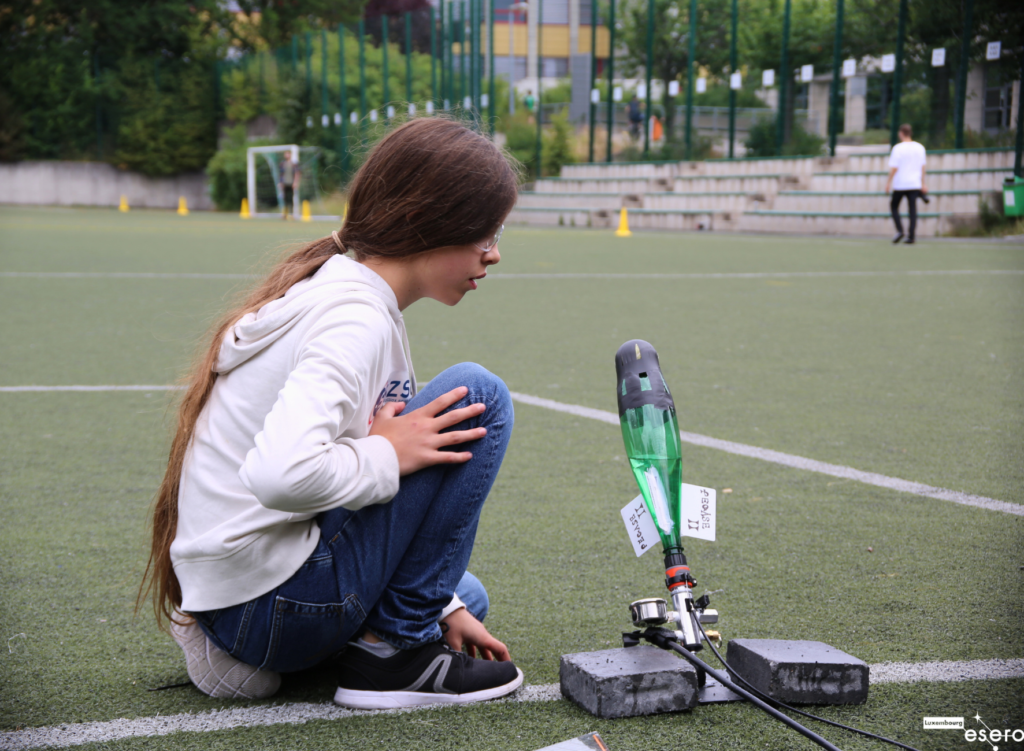
We invite schools and families to take on the Water Rocket Challenge, a fun and educational challenge that is free and open to children ages 8 to 14.
The objective? Land a water-propelled rocket as close as possible to a target 70 metres from the launch point.
In teams of 2 to 4 people, participants will build their own water rocket with the help of educational guides before launching it three times, adjusting various parameters such as air pressure, water quantity or launch angle. Accompaniment by a teacher or parent is required.
Registrations are now opened !
Find out more about this project at https://www.esero.lu/school-projects/water-rocket-challenge/?lang=en
Meet our new ambassador
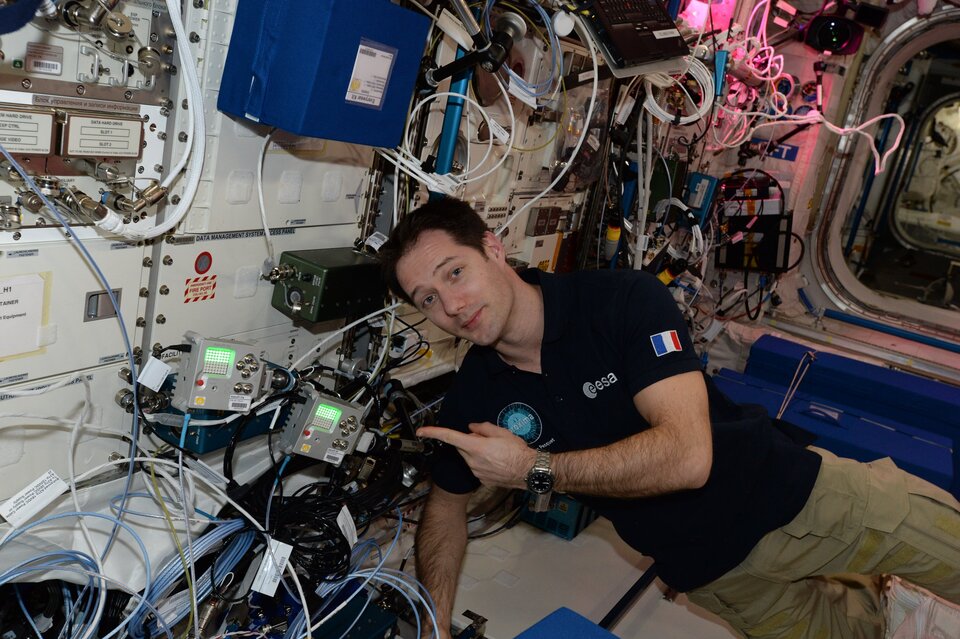
We are delighted to announce that ESA astronaut Thomas Pesquet will be the ambassador for Mission X, Astro Pi and Moon Camp this year. As projects that connect students with human spaceflight and space exploration, they are a perfect match for Thomas Pesquet’s experience as an astronaut and former ISS commander. Looking ahead, Thomas is also preparing for his next mission, having been selected to command a private astronaut mission to the International Space Station, currently planned for 2027.
Other STEM Educational activities – including Teacher Training
In addition to the school-level projects, ESA and the ESERO network offer many more resources to help you enrich your teaching using space as an example of real-life STEM applications and to spark your students’ curiosity.
The Teach with Space didactic resources are a set of ready-to-use curricular classroom resources for both primary and secondary school level. Each resource includes teaching guidelines and student activities that link space themes to STEM subjects.

The Hack an Exoplanet set of activities gives students aged 14-19 the chance to step into the role of space scientists. In this inquiry-based astronomy experience, students analyse real satellite data from four intriguing exoplanets. The exoplanets were observed in 2023 by ESA’s CHEOPS satellite, and the data (processed by ESA experts) are ready for students to explore using mathematical techniques and model fitting.
ESA Learn is ESA Education’s new online learning platform for teachers, educators and university students. Register for an account to enrol in currently open opportunities such as the self-paced Teach with Exoplanets course and stay up to date on future opportunities. The Teach with Exoplanets course is intended for teachers and educators who are interested in using astronomy in teaching. It is suitable for teachers and educators working with students aged 10-19 years, across different subjects such as mathematics and physics.
On the ESA Education YouTube channel you can also find a variety of videos to inspire and engage your students, from how-to guides and explainers, to experiments, interviews with space experts, and exclusive behind-the-scenes footage from ESA.